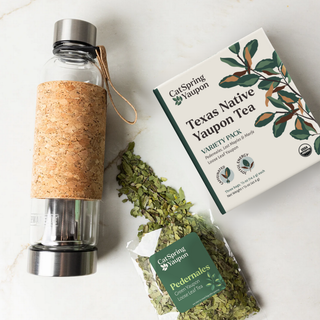


You're not quitting coffee tomorrow. That's okay. But something's shifted. Maybe the afternoon cup doesn't land the way it used to. Maybe the jitters before lunch have started feeling less like motivation and more like static. Maybe you've just started wondering what else is out there. A coffee alternative that actually feels good to drink.
This isn't a piece designed to talk you out of coffee. Coffee's earned its place in millions of mornings, and there's nothing wrong with that. This is an honest look at yaupon tea and coffee side by side: how each one works, how each one tastes, what each one costs, and when you might reach for one over the other.
Real numbers. Real taste notes. No shame for either drink.
What Happens When You Put Two Morning Drinks Side by Side
The kitchen smells like coffee. Rich, dark, almost insistent. It pulls you toward it before you're fully awake. In another mug, hot water meets yaupon leaves, and a different kind of steam rises. Softer. More herbal. Less in a hurry.
Both carry caffeine. Both have centuries behind them. But they aren't the same drink, and this comparison isn't about declaring a winner.
Yaupon tea (Ilex vomitoria) is America's only native caffeine. This native plant has been growing wild across the southeastern United States for centuries, long before coffee imports ever crossed an ocean.
Native American tribes, including the Timucua, the Calusa, and the Cherokee, brewed yaupon leaves into what they called the Black Drink, a social drink used in council meetings and ceremonies.
Indigenous peoples across the region traded the leaf widely, and European colonists later adopted it themselves, calling it Carolina tea. Yaupon was a common beverage straight through the Civil War. Then it nearly disappeared, pushed out by colonial attitudes, imported tea, and a slow cultural erasure. That heritage runs deep in American soil.
Today, the National Coffee Association reports that two-thirds of American adults drink coffee daily. Yaupon tea is making a quieter comeback, mostly among people looking for a coffee alternative that gives steady energy without the rollercoaster. Both caffeinated beverages contain caffeine, the compound that sharpens focus and wakes the brain.
But yaupon also contains theobromine, the same compound found in dark chocolate, which gives a slower, gentler lift. That's where the real difference begins.
We'll look at five things side by side: how each one hits your body, what each one tastes like, the caffeine math, the sourcing story, and when you might choose one over the other.
The Caffeine Math: How Each One Hits Your Body
Caffeine content is usually where people start. But the number alone misses most of the story.
Coffee hits fast. The caffeine content of a standard 8-ounce cup runs about 95 milligrams, peaking in your bloodstream around 30 to 45 minutes after that first sip. Your eyes snap open. Your mind sharpens. The energy comes on sharp, sometimes too sharp, especially on an empty stomach. Then, hours later, often around 3 p.m. if you drank at 7 a.m., the cliff arrives. The caffeine metabolizes, the lift vanishes, and you're frequently more tired than before you started. That's the coffee curve. Up fast. Down hard.
Yaupon tea works differently. Eight ounces gives you roughly 40 to 60 milligrams of caffeine per cup, about half of coffee's caffeine content. Here's the real distinction: yaupon tea contains theobromine alongside caffeine.
Research published in Physiology and Behavior shows that theobromine peaks 2 to 3 hours after ingestion and has an estimated half-life of 7 to 12 hours, compared to caffeine's 30-minute peak and 3 to 5 hour half-life. Together, they create a different energy curve entirely.
No sharp spike. Instead, a steady, joyful energy that builds gradually and holds for hours. No jitters. No crash. Just calm alertness, the kind of feeling you'd notice an hour into a long walk, when your mind has settled, and your body feels ready for whatever's next.
Coffee drinkers often need a second cup by afternoon just to stay level. With yaupon tea, many people find they don't hit that afternoon wall at all. The energy stays consistent from morning into early evening. Theobromine is the reason. It's not really a question of which drink has more caffeine per cup. It's a question of which curve fits how you actually live.
Yaupon tea has a lower caffeine content than coffee, but the theobromine extends and smooths the energy window. Steadier lift. Longer hold. No crash.
Taste Test: What Yaupon Tea Actually Tastes Like
Take a sip of coffee. It's bold. Complex. There's bitterness if you've brewed it hot, richness if you've brewed it well, sometimes a little acidic tang on the back of your tongue. Coffee's flavor comes from over a thousand aromatic compounds created during roasting. It's intense, layered, and demanding. The flavor asks something of you.
Now take a sip of yaupon tea. It's smooth. There's no bitterness, no matter how long the leaves sit in your water. Black tea, green tea, and oolong tea all come from the same plant, Camellia sinensis, and all of them turn harsh and astringent if you forget about them. That bitterness comes from tannins.
Yaupon holly is a different plant entirely. It doesn't carry those tannins. Steep it for two minutes, and it's delicate. Steep it for ten, and it's still smooth, still drinkable. Always smooth, never bitter, at any roast level.
If yaupon has a closest relative, it isn't tea at all. It's yerba mate, the South American holly that's been a daily ritual in Argentina and Uruguay for centuries. Yaupon holly and yerba mate share a botanical family and a similar alkaloid profile. Yaupon is North America's homegrown answer to mate, with a softer flavor and a gentler caffeine curve.
The comparison gets interesting when you look at how roasting changes the flavor. Just like coffee beans, yaupon holly tea can be roasted to different depths:
-
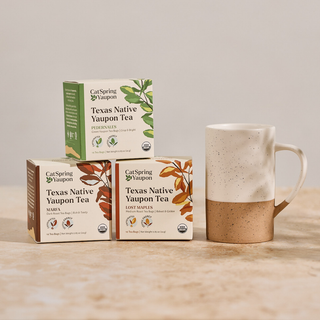
Pedernales Green Yaupon loose leaf is the lightest roast. Crisp, slightly grassy, alive. Light roast coffee drinkers recognize this one immediately. A subtle sweetness underneath that makes it easy to drink straight, no sugar required.
-
Lost Maples Medium Roast Yaupon tea splits the difference. Warm caramel notes with deeper earthy character, landing between green tea brightness and black tea richness. Forgiving even if you forget about it.
-
Marfa Dark Roast Yaupon loose leaf is where most coffee drinkers find their match. Toasted depth, rich complexity, the kind of robust flavor that feels familiar from the first sip. Always smooth, with a clean finish that lingers.
Yaupon tea doesn't need cream or sugar to be drinkable. Most people drink it straight because the flavor is naturally approachable, even for folks who usually need their coffee sweetened. Brew it hot. Pour it cold over ice. Make it into a latte.
Because bitterness isn't a factor at any steep time, you can't really mess up the brewing. It's impossible to over-steep, which is one of the cleanest practical differences between coffee and most other teas.
Yaupon tea isn't trying to be a coffee substitute. It's a coffee alternative on its own terms. Simpler, smoother, and consistently forgiving, no matter how you brew it.
Coffee is bold and complex. Yaupon is smooth and forgiving. Different experiences, not competing ones.
The Real Cost: Price Per Cup and the Sourcing Story
The price math is simple. Specialty coffee runs 12 to 20 dollars a bag and gives you about 12 to 20 cups, depending on brew strength. That's roughly $0.75 to $1.50 per cup.
Yaupon tea runs about the same per bag, usually $12 to $18, but it goes further. Most people steep a teaspoon or two of leaf per cup, while coffee drinkers use several tablespoons of beans. You're looking at $0.50 to $1.00 per cup. The per-cup difference isn't dramatic, but over a year it adds up.
The sourcing story is where the comparison gets more interesting. Coffee comes from thousands of miles away, grown in Central America, South America, Africa, and Asia.
The beans are picked, processed, dried, and shipped across oceans in containers, which makes the supply chain vulnerable to climate disruption and supply shocks. You've probably seen coffee prices spike when bad weather hits a major growing region.
Yaupon is a native plant that grows wild from Virginia to Florida to Texas. CatSpring wild-harvests it from 1,100 acres of Texas land. No long supply chains. No waiting months for a harvest from another continent. Yaupon requires no pesticides, no irrigation, almost nothing from the soil it evolved in. Just rain and time.
That's what it means to drink yaupon: America's only native caffeine, harvested at home. CatSpring is Regenerative Organic Certified and USDA Organic, founded by a citizen of the Chickasaw Nation and an Indigenous woman, and is Indigenous woman-owned.
None of this is meant to make anyone feel bad about coffee. It's just the math, and the story behind the math. Yaupon tea costs less per cup than specialty coffee and has a dramatically shorter, cleaner supply chain.
Which One Should You Drink?
There's no winner here. Coffee and yaupon tea are different tools for different mornings and different times of day.
- If you love coffee, the ritual of brewing it your way, and the bold intensity of the flavor, keep drinking it. There's nothing wrong with that.
- If you want steady energy through the whole afternoon without disrupting your sleep, yaupon fits.
- If you want lower caffeine but still want something warm and real in your hands, yaupon fits.
- If you want a drink that's impossible to mess up, that's yaupon, too. It isn't decaf, and it isn't trying to be. It's its own caffeinated beverage, with its own rhythm.
Most people don't choose between them. They rotate. Coffee in the morning for that sharp lift while they're still waking up. Yaupon in the afternoon, when they want to focus without keeping themselves awake at midnight. That isn't indecision. That's using the right cup for the right moment.
If you're curious about trying yaupon tea, a dark roast is the easiest place to start. It's closest to what you already know, and the toasty depth feels familiar even though the experience is gentler. Or grab a sampler to taste the full range, from bright and herbal to rich and earthy. Steep it for two minutes or five. You really can't get it wrong.
Coffee and yaupon serve different needs. Most people find them complementary, not competing. Try both and let your body tell you what fits.
FAQs: Yaupon Tea
How does yaupon tea caffeine content compare to coffee?
A standard 8-ounce cup of yaupon tea contains roughly 40 to 60 milligrams of caffeine. That's about half the caffeine compared to a standard cup of coffee, which typically runs 95 to 180 milligrams per cup. The lower caffeine content is part of why yaupon tea works as a coffee alternative for people who want to scale back without going to decaf. The other part is the theobromine, which smooths the energy curve out across the afternoon.
Is yaupon tea the same as yerba mate?
Not the same, but related. Yaupon holly (Ilex vomitoria) and yerba mate are both members of the holly family, and they share a similar alkaloid profile, including caffeine and theobromine. Yerba mate grows in South America. Yaupon is its North American counterpart, a native plant of the southeastern United States. Yaupon tea tends to taste smoother and less grassy than yerba mate.
Why doesn't yaupon tea get bitter like other teas?
Black tea, green tea, and oolong tea all come from Camellia sinensis, the tea plant of Asia. The bitterness in those teas comes from tannins, which release more aggressively as the leaf sits in hot water past a certain point. Yaupon holly has almost no tannins. Over-steeping doesn't ruin the cup, which makes it easier on the stomach and forgiving for anyone who tends to forget the kettle.
How do you brew yaupon tea?
Heat your water to about 180 to 195°F, just below boiling water. Add a teaspoon or two of loose-leaf tea or one tea bag, then steep for 5 to 7 minutes. Yaupon requires no special equipment, no scale, no precise timing. Brew it hot for a morning ritual. Brew it strong and pour it over ice for an afternoon iced tea. You can't really get it wrong.
Why is it called Ilex vomitoria if it's safe to drink?
The Latin name is misleading, and the story behind it is worth knowing. A Scottish botanist named the plant in the 18th century, after observing a ceremonial purification practiced by some Native American groups along the southeastern coast. That ritual used yaupon brewed with other herbs in large quantities, and the purging was part of the ceremony, not a property of the leaf itself. On its own, as a daily social drink, yaupon tea has been consumed safely for thousands of years.
Is the yaupon industry still small?
Smaller than the global tea industry, yes, but growing. The American Yaupon Association represents the small but expanding group of growers, harvesters, and brands working to bring this native plant back into daily American life. Most yaupon tea you'll find is sourced from a handful of regional producers in Texas, Florida, and the Carolinas.
Find Your Steady, Joyful Energy
The best morning drink is the one that works for your body and fits your actual life. Coffee's been doing that for millions of people for centuries. Yaupon tea has been doing it on American soil for even longer, used by indigenous peoples of the southeastern United States for generations before coffee ever arrived. Both are real traditions. Both deserve respect.
Maybe the answer is coffee. Maybe it's yaupon tea. Maybe it's both, rotating through your day depending on what you need. The only way to know is to stop reading comparisons and start tasting.
Grab a loose-leaf yaupon variety pack, steep whichever roast calls to you first, and notice what happens. Your steady, joyful energy is waiting. One cup at a time.


