

There's a particular kind of tired that coffee makes worse.
You know the one. You pour a second cup mid-afternoon, hoping it'll smooth out the 3 PM fog, and instead your heart ticks a little faster, your shoulders creep toward your ears, and your focus scatters in four directions at once. The jitters aren't productivity. They're stress wearing caffeine's clothes.
If you've been caught in that loop, you're not alone. Plenty of people who quit coffee didn't quit because they hated it. They quit because their body kept sending the same message: this isn't working anymore. What most of them found on the other side wasn't a caffeine-free life. It was a smarter relationship with caffeine — one built around teas that calm the nervous system while keeping the mind clear.
Let's walk through some of the best teas for stress relief: what makes each one work, how to brew it well, and how to match it to your specific stress pattern. Whether you're wired and tired, anxious and scattered, or simply burned out, there's a cup here that fits.
Why Your Coffee Habit Might Be Fueling Your Stress
Coffee doesn't cause stress. But for many people, it amplifies it.
Coffee raises cortisol, the body's primary stress hormone. A morning cup when cortisol is already naturally peaking can push those levels higher than your body actually needs. The result isn't alertness. It's low-grade anxiety that feels like urgency but accomplishes nothing useful.
Then there's the crash. Coffee's caffeine hits fast and wears off fast. When it drops off, your body compensates by releasing more cortisol and adrenaline. That 3 PM slump isn't laziness. It's your adrenal system trying to catch up.
That's where calming tea comes in. Many of the best herbal teas for stress relief work not by sedating you but by supporting your nervous system's natural ability to regulate. Some contain L-theanine, which encourages alpha brain wave activity: the kind associated with relaxed focus. Others use adaptogens to help keep cortisol within a healthier range. A few are caffeine-free, designed to signal rest without requiring it.
If coffee has started to feel like a stressor rather than a solution, replacing your second cup in the afternoon with something more supportive is one of the most practical shifts you can make. Notice what changes in your energy, your shoulders, and your sleep quality.
The Best Teas for Stress and Anxiety Relief
These seven options cover the full range of what stress looks and feels like. Each one has a different mechanism, flavor profile, and role in your day. Which tea is best for stress depends on which kind of stress you're managing.
1. Chamomile Tea
Close your eyes and picture the simplest version of calm. Chances are it looks something like chamomile tea: a warm cup, a quiet moment, the gentle sweetness of dried flowers releasing into hot water.
Chamomile has been used for centuries to reduce anxiety and promote restful sleep. It contains apigenin, a plant compound that acts on benzodiazepine receptors in the brain — producing calm without the side effects of stronger interventions. Long-term chamomile use has been shown to reduce symptoms of generalized anxiety disorder, improve sleep quality, and relax the muscles of the digestive tract, which is often where stress shows up physically.
Use one tea bag or a tablespoon of loose herb, steep for 5 to 7 minutes at 200°F, and add honey to deepen the sweetness. Chamomile blends well with lavender or lemon balm for a more complete evening ritual.
Best for: bedtime routines, digestive calm, breaking the cortisol cycle before sleep.
2. Lavender Tea
Lavender doesn't ask much of you. Hold the mug and let the steam reach you first. Something in the body starts to loosen before the first sip.
Lavender's active compound, linalool, inhibits sympathetic nervous activity and excites the parasympathetic system — making lavender tea as much a sensory experience as a physical one. Research has documented its ability to relieve stress and promote relaxation across multiple stress mechanisms simultaneously.
Steep at 195°F for 3 to 5 minutes, covered. Lavender is potent, so lighter is better. It blends beautifully with chamomile tea or lemon balm, and a splash of milk and honey turns it into a proper evening ritual.
Best for: anxiety spirals, tension that lives in the body, nervous system downregulation before bed.
3. Lemon Balm Tea
Lemon balm is one of the quieter members of the mint family, but its calming effects are anything but subtle. This fresh, citrus-bright herb has been used for centuries to ease restlessness, and research confirms it can boost mood, improve cognitive function, and support mental health by keeping the nervous system from running too hot.
Lemon balm works by inhibiting GABA-T, the enzyme that breaks down GABA — effectively preserving the nervous system's natural brake pedal. The result is a quieter, less reactive mental state without the foggy feeling that stronger sedatives produce. It's caffeine-free and gentle enough for daily use.
Use a tea bag or a tablespoon of fresh herb in hot water at 200°F for 5 to 7 minutes. Add honey if the brightness feels sharp.
Best for: mood support, cognitive calm, chronic stress that shows up as irritability or mental restlessness.
4. Green Tea
Green tea occupies a middle ground that most other teas can't.
It contains caffeine for focus and mental clarity, plus L-theanine to smooth caffeine's sharp edges into something steady. L-theanine is an amino acid that promotes relaxation without drowsiness and reduces stress-related symptoms including anxiety and sleep disturbance. Sencha green tea is particularly high in L-theanine. It comes from the Camellia sinensis plant, processed to preserve these calming compounds.
Steep at 175°F for 2 to 3 minutes. Boiling water makes most green teas bitter, so lower temperature matters here. If coffee has been creating anxiety, green tea is often the first swap worth trying: the caffeine is gentler, and the L-theanine does real work on stress.
Best for: calm focus, mental clarity, a gentle caffeinated step away from coffee.
5. Peppermint Tea
The first sip of peppermint tea does something immediate. The cool opens your airway. The mind pauses, and in that pause, something loosens.
Peppermint's menthol relaxes smooth muscle tissue throughout the body, including the digestive tract. Research shows peppermint also reduces cortisol secretion from the adrenal gland — and the sensory quality of mint, bright and clarifying and clean, creates a physical reset that can interrupt the mental spiral of a stressful afternoon. It's caffeine-free, making it ideal for midday when you want mental clarity without more stimulation.
Steep for 5 to 7 minutes at 200°F. Fresh mint is noticeably brighter than dried. Add honey if the sharpness feels like too much.
Best for: digestive calm, midday mental reset, stress that shows up in the stomach.
6. Ashwagandha Tea
Ashwagandha doesn't create calm directly. It helps your body find its own way back to balance.
As an adaptogen, ashwagandha interacts with the hypothalamic-pituitary-adrenal (HPA) axis to help cortisol stay in a healthier range over time. Multiple randomized controlled trials confirm it significantly reduces morning cortisol, anxiety scores, and perceived stress compared to placebo — with benefits accumulating over 60 days of consistent use. Use a decoction method: simmer in hot water at 200°F for 10 to 15 minutes to extract more active compounds. It blends well with ginger, cinnamon, honey, and milk.
Many ashwagandha herbal blends include holy basil (tulsi), another adaptogen with documented anxiolytic properties. Together they form a long-term foundation for nervous system resilience.
Best for: burnout, chronic stress, building calm that lasts longer than a single cup.
7. Yaupon
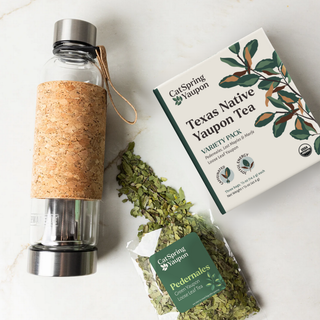
Yaupon is the only naturally caffeinated plant native to North America, wild-harvested in Texas and hand-roasted in three distinct profiles. Unlike most teas from the Camellia sinensis plant, yaupon contains no tannins — which means no bitterness, no astringency, and no steep timer to watch. It's impossible to over-steep.
What makes yaupon particularly useful for stress management is its combination of compounds. It contains caffeine for alertness, L-theanine for calm focus, and theobromine — the same compound in dark chocolate that produces a gentle mood lift — for sustained energy that doesn't spike or crash. The result is what yaupon drinkers consistently describe as steady, joyful energy: focused without the edge, present without the pressure.
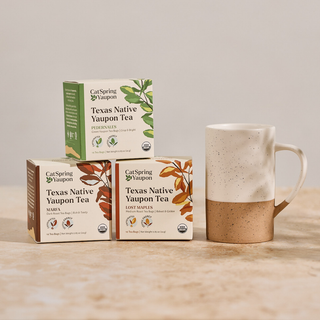
At CatSpring Yaupon, yaupon comes in three roasts:
- Pedernales is green, crisp, and bright — best for morning clarity
- Lost Maples is medium, golden, and balanced for all-day drinking
- Marfa is dark and roasted, ideal for those stepping away from coffee
Steep any roast for 3 to 5 minutes at 200°F. Add honey to deepen the natural sweetness, though most people find they don't need it.
Best for: replacing coffee without losing focus, steady energy without the crash, anyone who wants caffeine that works with them rather than against them.
Matching Tea to Your Stress Pattern
Which tea is the best drink for stress relief? It depends on what kind of stress you're managing. Here's a simple framework.
Wired and tired. Cortisol is high, energy quality is poor, and more stimulation makes everything worse. Start with a Pedernales green yaupon roast for smooth, sustained energy without pushing cortisol higher. Shift to peppermint tea in the afternoon for focus without more caffeine. Wind down with chamomile tea in the evening to relieve stress and break the cortisol cycle before sleep.
Anxious and unfocused. Lots of mental activity, not much of it useful. A medium yaupon roast in the morning pairs caffeine with L-theanine for calm focus. Lemon balm at midday quiets racing thoughts. Lavender tea in the evening helps the nervous system downregulate and supports better sleep.
Burned out. Low motivation, low energy, high emotional exhaustion. Begin with an ashwagandha herbal blend to start building the adaptogenic foundation your body needs. In the afternoon, yaupon's gentle, sustainable caffeine is easier on depleted adrenal systems than coffee. Chamomile tea in the evening supports overnight recovery.
Match your tea to today's stress pattern, not a fixed routine. Your needs shift. Your cup can shift with them.
How to Brew for Maximum Calm
Most people reach for boiling water out of habit, but boiling water at 212°F can destroy delicate calming compounds in herbal tea. Most calming teas do best at 195 to 200°F. If you don't have a temperature-controlled kettle, letting boiled water rest for 90 seconds gets you close enough.
Cover your mug while the tea steeps. Many of the volatile oils responsible for lavender's calming effects and chamomile's sweetness are lost in the steam. Covered steeping keeps them in the cup.
The five-minute pause before brewing is its own stress-management practice. Measuring the herb, watching the color bloom in hot water, holding a warm cup before the first sip — these sensory acts engage the parasympathetic nervous system, the rest-and-digest branch that stress suppresses. The ritual of making tea can, by itself, help lower stress levels.
Start wherever you are. A tea bag and a quiet minute count.
Your First Cup
Choose the stress pattern above that sounds most like you. Pick the tea that fits. Brew it tomorrow with five minutes of intention instead of distraction.
You don't have to give up coffee or overhaul your habits to feel a difference. You just have to introduce something that supports your nervous system instead of straining it.
If you're curious about yaupon, the CatSpring Yaupon starter kit includes all three roasts. Smooth, naturally sweet, impossible to over-steep, and grown wild in Texas.
What tea clears mental tension and quiets the mind? The one you actually brew. One cup at a time.


