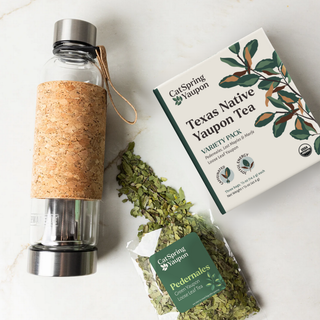


There's a story that runs deeper than most people know when they pick up a cup of yaupon.
Recently, Chokma magazine published a beautiful piece about CatSpring Yaupon by writer Elaina Eddlemon. Chokma is a publication of the Chickasaw Nation, and the piece appeared in print while sharing our story with the Chickasaw community in a way that felt deeply meaningful to us. CatSpring Yaupon is an Indigenous, woman-owned company founded by Abianne Falla, a citizen of the Chickasaw Nation.
We wanted to bring some of that conversation here, in our own words. Because the history of yaupon and the story of why we do what we do — it deserves to be told again and again.

The Plant That Survived Everything
In 2011, Texas experienced its driest year on record. Oak trees were dying. Ranchers were selling off their cattle. Fields that had been green for generations went brown and stayed that way.
But one plant kept going.
"The only thing that was still kind of surviving was the yaupon," Abianne remembers.
That resilience caught her attention. Around Cat Spring, Texas, yaupon wasn't mysterious; it was the stubborn, unchecked plant that grew along fence lines and had to be cleared from trails. Most people didn't think twice about it. But that drought year, watching everything else fail while yaupon thrived, something shifted.
She started reading. Studies coming out of Texas A&M and the University of Florida were diving into yaupon and its traditional uses. And what she found was extraordinary.
A Legacy That Was Always There
Yaupon — Ilex vomitoria — is the only caffeinated plant native to North America. And long before colonization rewrote the story, it was central to the lives of the people who called this land home.
"There's this incredible legacy," Abianne explained in the Chokma piece. "Virtually every tribe along the Gulf Coast had a tradition with yaupon, and it was traded all over what's now the U.S. and down into Mexico."
For the Chickasaw people and many other First American nations, yaupon wasn't just a drink; it was a ceremony, a community, and medicine. The plant grows abundantly in the historic Chickasaw Homeland and is even grown today in the Spiral Garden at the Chickasaw Cultural Center in Sulphur, Oklahoma.
So why did it disappear from American culture?
The scientific name tells part of the story. Ilex vomitoria — "vomiting holly" — was assigned by botanists who, according to Abianne, had never come to North America. Some historians speculate they may have had ties to the East India Tea Company and an interest in making domestic plants seem less desirable than imported ones. It worked. Yaupon's reputation was tarnished. The tradition faded.
But the plant didn't disappear. It kept growing. Quietly. Unconquered.
Bringing It Back, the Right Way
CatSpring Yaupon was born in 2013 from Abianne's experimentation with preparation methods: how to bring out the best of what the plant offered while honoring the traditional processes that came before.
"We try to observe, but at the same time, we have to follow good food manufacturing practices," she told Chokma. "So, we adapt as much as we can into modern food standards but also try to recreate the same taste that you would get from the traditional process."
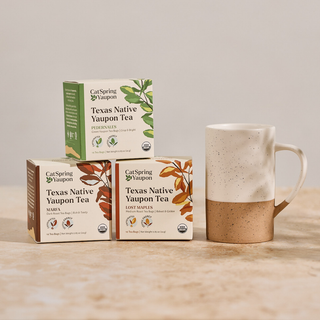
The result is three distinct roasts and each named for a Texas landscape, each reflecting a different depth of flavor:
- Pedernales Green Yaupon loose leaf is the lightest roast. Crisp, slightly grassy, alive. Light roast coffee drinkers recognize this one immediately. A subtle sweetness underneath that makes it easy to drink straight, no sugar required.
-
Lost Maples Medium Roast Yaupon tea splits the difference. Warm caramel notes with deeper earthy character, landing between green tea brightness and black tea richness. Forgiving even if you forget about it.
-
Marfa Dark Roast Yaupon loose leaf is where most coffee drinkers find their match. Toasted depth, rich complexity, the kind of robust flavor that feels familiar from the first sip. Always smooth, with a clean finish that lingers.
What makes yaupon unlike any imported tea is what it doesn't have. No tannins, which means no astringency, no bitterness, no need for sweeteners. Just the clean, smooth flavor of the plant itself.
And then there's the energy. Yaupon contains caffeine, theobromine, and theacrine, three compounds that work together to produce what customers consistently describe as something they can't quite find anywhere else.
"Those three together give this really gentle mental boost that, anecdotally, we're most often told, is like a joyful energy," Abianne explained. "People are looking for energy that isn't extractive."
Stewardship Is the Work
The word Abianne returns to again and again is stewardship.
"I think that's what really drives me. It's like this really incredible opportunity to be a steward of such an amazing plant."
That stewardship shows up in how CatSpring harvests. Yaupon is a wild-grown plant, not a planted crop. It spreads when native grasslands are degraded — so harvesting it selectively is actually an act of restoration. The more land they harvest, the more land they can rewild.
Independent research backs this up. Their grassland restoration work has shown a 7% improvement in soil carbon storage, a 70% increase in biodiversity, and the restoration of up to 31% of rainfall infiltration previously blocked by a dense canopy (PlanetFWD and Texas A&M).
CatSpring has also been awarded a $1.57M USDA Conservation Innovation Grant to implement grassland restoration on 500 acres over the coming years, in partnership with Texas Parks and Wildlife, the Oaks and Prairie Joint Venture, and the American Bird Conservancy.
They are Regenerative Organic Certified, the most rigorous standard in sustainable agriculture — the first yaupon producer to hold it. And they're pursuing FairWild Certification for their wild-harvested yaupon, the first for any yaupon producer in the USA. {note from Abianne: since publication, we have received Fair Wild and are now certified.}
Stewardship also means the people doing the harvesting. CatSpring works with parole officers to hire individuals seeking to rebuild their lives — offering flexible employment designed to break the cycles that keep people trapped.
"We wanted to be really intentional in how we harvest and how we hire," Abianne said.
A Catalyst for Restoration
"I believe yaupon is a catalyst for restoration," Abianne told Chokma. "I think it is for our bodies, for our community, for our land, and for the industry."
That's the belief that started CatSpring Yaupon and still drives it. A plant that was dismissed, renamed to sound dangerous, and left to grow unnoticed along Texas fence lines, which turns out to be one of the most remarkable things growing in North America.
It's been here all along. And it's not going anywhere.
— Abianne Falla, Founder, CatSpring Yaupon
This post draws on an article by Elaina Eddlemon published in Chokma, a publication of the Chickasaw Nation. We're grateful to Chokma for telling our story to the Chickasaw community.


